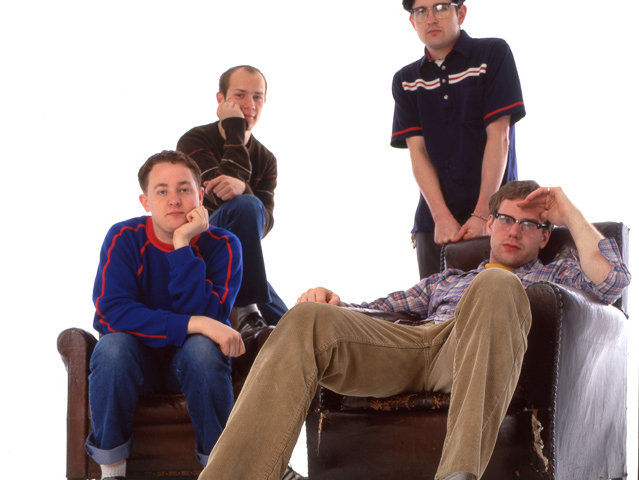
Menomena
- Nov 22, 2025
- 5 min read
Updated: Nov 27, 2025
Menomena emerged from Portland, Oregon in 2000 as one of the city’s most inventive and quietly influential experimental rock groups. Formed by multi-instrumentalists Justin Harris, Danny Seim, and Brent Knopf, the trio began as an offshoot of Seim’s home recording project Lackthereof, only becoming its own entity when Knopf returned from college and began collaborating with the others. From the beginning Menomena operated with a sense of curiosity and playfulness that belied the depth of their musical ideas. Even their name, chosen mostly for the way it sounded, set the tone for an approach that embraced ambiguity and instinct over neat explanations. The band’s defining characteristic was its distinctive, democratic, and labor-intensive compositional method, which involved building tracks from spontaneously recorded loops using their custom-programmed software, Deeler (Digital Looping Recorder). This process resulted in a sound described by critics as a blend of "controlled chaos," where shifting, complex rhythms, unusual instrumental combinations, and sudden dynamic turns coexisted within tightly constructed art-rock and psychedelic pop structures. Known for their meticulous, often elaborately packaged albums and their refusal to use backing tracks live, Menomena carved out a singular, influential space in independent music before an extended hiatus, returning in 2024 to celebrate their distinctive and enduring body of work.

Biography
The group played its first show at the Meow Meow in Portland during the summer of 2001 and quickly developed a reputation for both their adventurous recordings and their irreverent sense of humor. Behind the scenes they were building their process around the custom-made looping and composition tool called the Digital Looping Recorder, or Deeler, which Knopf programmed in Max. Rather than crafting songs through traditional rehearsals, the band passed a single microphone around the room, layering improvised ideas over a shared click track. Each member added short rhythmic or melodic fragments that Deeler looped and stacked. The songs then evolved through a slow process of editing, sculpting, trading files, and revising. This democratic and highly fragmented method gave Menomena their unmistakable quality of controlled chaos, where shifting rhythms, unusual instrumental combinations, and sudden dynamic turns coexisted within tightly constructed structures.
Their debut album, I Am the Fun Blame Monster, arrived in 2003 as a self-released flipbook art object as much as a record, with Seim designing and hand-assembling dozens of 80-page books at his job at Kinko’s. The album’s unusual presentation matched its sound, a collection of dense rhythmic collisions and melodic detours that introduced the band’s idiosyncratic vision. A national release through FILMguerrero in 2004 brought wider attention, and over time I Am the Fun Blame Monster became recognized as one of the more distinctive underground debuts of its era. Tracks like “Strongest Man in the World” later reached new audiences through the soundtrack to Gus Van Sant’s film Paranoid Park, further linking Menomena to the artistic culture of their hometown.
The follow up album, Under an Hour, released in 2005, showed a different side of the band. Composed originally for an experimental dance performance by Portland’s Monster Squad, the record consisted of three long instrumental pieces, each stretching beyond seventeen minutes. Its sprawling, exploratory quality hinted at the group’s range and their willingness to detach themselves from conventional structures. Two years later the band tightened its focus again with Friend and Foe, released in 2007 through Barsuk in the United States and City Slang in Europe. Entirely self-recorded and mixed, the album delivered some of their most immediate and intricately layered work, accompanied by an elaborate die-cut package designed by graphic novelist Craig Thompson. The record brought Menomena a new level of visibility, including a Grammy nomination for Best Recording Package and extensive touring across the United States and Europe. They shared stages with groups like Gang of Four, The National, and The Long Winters, and their tours became known as unpredictable, communal, and occasionally chaotic affairs, including the now legendary breakdowns of their 1977 RV, which they called RV Danger.
Menomena returned in 2010 with Mines, an album shaped by long periods of remote collaboration and painstaking editing. The band members often worked separately, passing ideas digitally, disappearing into their own creative spaces, and returning to reshape each other’s contributions. The result was a record marked by emotional tension and meticulous detail, an extension of the cut-and-paste method that had always defined their work. Shortly after its release Knopf departed to focus on his project Ramona Falls, leaving Harris and Seim to continue Menomena as a duo. The transition brought a new dynamic to the group and led to the creation of Moms in 2012, an album deeply rooted in personal history and family relationships. It was their most lyrically direct and thematically cohesive record to date, revealing another side of the band’s evolving sensibility.
Throughout their career Menomena approached live performance with the same inventiveness that shaped their recordings. Refusing to use backing tracks, they recreated their densely layered songs by constantly switching instruments, triggering effects, and expanding arrangements in real time. Harris might move between guitar, baritone guitar, bass, saxophones, and foot-operated synthesizers, while Seim anchored the music with drums and vocals. At times they brought in collaborators such as 31Knots member Joe Haege to expand the live configuration, and in some European performances artist Craig Thompson painted large ink pieces on stage during the set, tearing them apart and handing the fragments to the crowd at the end of each show.
Following an extended hiatus beginning in 2014, the band remained quiet for more than a decade as members pursued various creative avenues. Seim continued his work as Pfarmers alongside Bryan Devendorf and Dave Nelson, while Harris contributed to projects across the Portland musical community. In 2024 Menomena unexpectedly returned with The Insulation EP, their first new music since Moms and their first release in twelve years. The announcement also included digital reissues of their catalog and the news that Knopf would rejoin Harris and Seim for a live performance of I Am the Fun Blame Monster in Portland, their first show in ten years and their first with the original lineup since 2011.
Watch
"Wet And Rusting" Music Video
"Rose" Live
Personnel
Justin Harris (Bass, baritone saxophone, alto saxophone, guitar, baritone saw, vocals)
Danny Seim (Drums, percussion, piano, vocals)
Brent Knopf (Guitar, keyboards, glockenspiel, piano, organ, vocals)
Joe Haege (Live instrumentation, vocals)
Discography
I Am the Fun Blame Monster (2003) The debut album, self-released initially as a hand-assembled flipbook. It introduced the band’s dense, loop-heavy compositional style, blending experimental rock with melodic psychedelic pop. Key tracks include the propulsive and dynamic “Cough Coughing” and “Strongest Man in the World,” which later found a wider audience.
Under an Hour (2005) A significant stylistic departure, this instrumental album was originally composed for a modern dance performance. It consists of three long, ambient, and exploratory pieces, highlighting the band's post-rock tendencies and range beyond conventional song structures.
Friend and Foe (2007) Their Barsuk Records debut, this album delivered a more immediate and focused sound while maintaining the intricate layering of their previous work. It earned a Grammy nomination for its unique die-cut packaging and features some of their most recognized songs. Key tracks include the insistent, horn-laden “Wet and Rusting” and the intricate “Evil Bee.”
Mines (2010) An emotionally charged album shaped by long-distance collaboration and intense editing, Mines further refined their meticulously detailed, cut-and-paste method. The album is marked by emotional tension and meticulous craft. Standout tracks include the surging, cathartic “Queen Black Acid” and “TAOS.”
Moms (2012) The first album recorded as a duo following Brent Knopf’s departure, Moms is the band’s most personal and lyrically direct work. Focused on themes of family and loss, the album is noted for its thematic cohesion and lyrical impact. Key tracks include the aggressive yet emotive “Heavy Is As Heavy Does” and “Plumage.”
The Insulation EP (2024) A surprise return after a twelve-year hiatus, this EP marked the band's first new music since 2012, hinting at the re-ignition of their distinctive experimental energy.